Finding a reliable timegrapher does not require a large repair-shop budget. The best watch timing machines under $50 can help hobbyists, collectors, and beginner watchmakers check rate, beat error, amplitude, and beat frequency before or after servicing a mechanical watch.
Our roundup focuses on affordable testers with practical features such as acoustic pickups, multifunction displays, portable designs, and straightforward calibration controls. Use the guide below to match the right machine to your watches, workspace, and repair goals.
Best 10 Watch Timing Machines Under 50 Picks for 2026
Best Compact Option

- Tests mechanical-watch timing accuracy and rate
- Measures just 5.9 x 8.9 x 4.9 cm
- Lightweight 51 g design with USB input
Best For: Small workspaces and portable basic checks
Best Feature-Rich Tester

- Measures amplitude, frequency, rate, and waveform
- Includes rise-angle settings
- Noise-reduction components and hard-plastic housing
Best For: Amateur watchmakers needing broader diagnostics
Best Lightweight Workbench Pick
- Built for quick daily-rate checks
- Compact 51 g gray instrument
- USB input and front watch holder
Best For: Portable calibration on small workbenches
Professional Pick
NO.1000 Multifunction Timegrapher

- Tests almost all mechanical watches
- Multifunction timing measurement
- Compact corded-electric design
Best For: Watchmakers and mechanical-watch collectors
Portable Choice
High-Sensitivity Watch Timing Machine
- Compact 3.5 x 2.32 x 1.93-inch body
- Built-in front watch holder
- USB-powered portable design
Best For: Mobile testing and compact workbenches
Hobbyist Option
Lightweight Gray Watch Timing Machine
- Checks mechanical-watch timing and rate
- Compact lightweight construction
- Includes holder and USB input
Best For: Hobbyists and compact workbench setups
Best Overall Value
Watch Tester Timegrapher No.1000
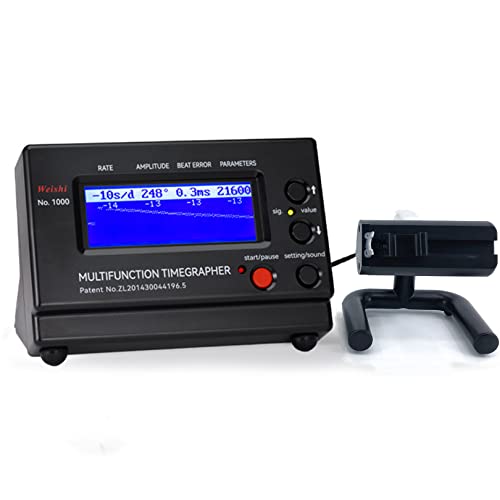
- Displays rate, amplitude, beat error, beat, and lift angle
- Automatically adjusts signal level for different watches
- Includes one-year warranty and customer support
Best For: Collectors and hobbyists seeking simple mechanical-watch testing
Best for Adjustable Testing
YaeTek Multifunction Timegrapher
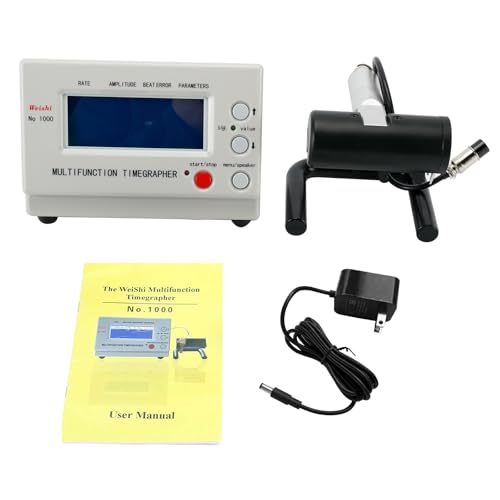
- Provides six adjustable testing positions
- Offers selectable 2–60 second sampling periods
- Calculates rate, amplitude, and beat error automatically
Best For: Collectors wanting flexible mechanical-watch testing controls
Best Feature Set
Multifunctional Watch Timegrapher
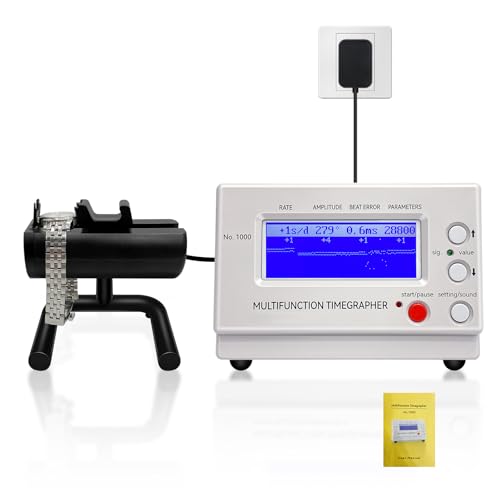
- Tests rate, amplitude, polarity, beat, lift angle, and period
- Supports 2–60 second sampling and up to six directions
- Offers wide-voltage input and a 365-day warranty
Best For: Enthusiasts and technicians needing detailed movement diagnostics
Best Multifunction Pick – USB Watch Timegrapher
For shoppers comparing watch timing machines under 50, this multifunction timegrapher stands out for its broad measurement set and computer-transfer capability. It measures daily rate, amplitude, beat error, frequency, polarization, and waveform, while adjustable sliding jaws help accommodate different watch sizes.
Best For: Hobbyists who want detailed mechanical-watch readings and PC data transfer.
Pros:
- Measures daily rate, amplitude, beat error, frequency, and waveform.
- Supports frequency and ascending-angle settings.
- Adjustable removable jaws fit various dial sizes.
- Transfers data to tablets, laptops, and desktops through USB/RS232.
Cons:
- The notes do not specify included software or computer requirements.
- Its compact controls may be less convenient for users wanting a larger display.
Choose this model if measurement flexibility and connectivity matter more than having the simplest possible tester. Its indicator light and adjustable holder also make routine setup straightforward.
Best Compact Option – Portable Watch Timing Machine
Among watch timing machines under 50, this portable gray tester is aimed at quick accuracy and rate checks without taking up much bench space. Its compact 5.9 x 8.9 x 4.9 cm body and 51 g weight make it easy to position in a small workspace.
Best For: Enthusiasts and repair users who prioritize portability and basic timing checks.
Pros:
- Designed to test the timing accuracy and rate of mechanical watches.
- Very compact and lightweight at 51 g.
- Includes a built-front watch holder and USB power input.
- Suitable for workspaces where bench room is limited.
Cons:
- The notes do not list advanced measurements such as amplitude or beat error.
- They do not specify the USB power adapter or accessories included.
This is a practical choice for straightforward checks and easy storage. Consider another model if you need a broader set of diagnostic readings or detailed computer analysis.
Best Feature-Rich Tester – Mechanical Watch Timegrapher
This mechanical watch timegrapher is a strong contender among watch timing machines under 50 for users seeking multiple diagnostic views. It can measure daily difference, polarization, amplitude, frequency, dotted line, and waveform, with rise-angle settings and noise-reduction hardware.
Best For: Amateur watchmakers who want several readings in a rugged, dedicated tester.
Pros:
- Measures daily difference, polarization, amplitude, frequency, and waveform.
- Includes rise-angle settings for more detailed analysis.
- Uses ceramic filter capacitors, signal-processing chips, and foam for noise and shock reduction.
- Has a hard-plastic housing and digital display.
Cons:
- The listed power source is battery powered, which may require battery replacement.
- The notes do not specify the battery type or operating time.
Its combination of measurement coverage and noise-conscious construction makes it suitable for more involved bench work. It is a better fit than a basic rate tester when you want to inspect several aspects of movement performance.
Best Lightweight Workbench Pick – High-Sensitivity Watch Timer
For buyers browsing watch timing machines under 50, this high-sensitivity model focuses on convenient timing checks in a small package. It is designed for mechanical-watch calibration and measures 5.9 x 8.9 x 4.9 cm while weighing 51 g.
Best For: Hobbyists and professionals who need a lightweight calibration instrument for quick checks.
Pros:
- Designed for quick, reliable daily-rate checks and adjustments.
- Compact 51 g design fits easily on a workbench.
- Built-front watch holder helps position the timepiece.
- Includes a side USB power input and a high-sensitivity design.
Cons:
- The notes do not identify specific advanced measurements.
- They do not clarify whether a power adapter is included.
This model makes sense when portability and simple calibration are the priority. Its feature list is less detailed than that of a full diagnostic timegrapher, so confirm your measurement needs before buying.
Professional Pick – NO.1000 Multifunction Timegrapher
For shoppers comparing watch timing machines under 50, the NO.1000 is a practical corded-electric option designed to test almost all mechanical watches. Its multifunction setup measures beats per unit time and is positioned for both professional watchmakers and collectors.
Best For: Watchmakers and collectors who want a versatile, workbench-focused tester for mechanical watches.
Pros:
- Designed to test almost all mechanical watches.
- Multifunction timegrapher format for timing checks.
- Compact modern design measuring 6.77 x 1.57 x 4.49 inches.
- CE specification and corded-electric operation.
Cons:
- Requires a corded power source.
- Compatible devices are limited to mechanical watches.
The NO.1000 stands out when broad mechanical-watch compatibility and a traditional workbench setup matter more than portability. It is a sensible choice for regular testing at home or in a watchmaking workspace.
Portable Choice – High-Sensitivity Watch Timing Machine
Among watch timing machines under 50, this high-sensitivity model emphasizes portability for quick daily checks. Its compact body, lightweight construction, built-in holder, and USB rear input make it convenient for a small workspace or mobile kit.
Best For: Enthusiasts and professionals who need a lightweight timing tester for routine mechanical-watch checks.
Pros:
- Compact dimensions of 3.5 x 2.32 x 1.93 inches.
- Lightweight design intended for portability.
- Built-front watch holder supports convenient testing.
- USB rear input terminal for power.
Cons:
- The supplied notes do not specify compatibility beyond mechanical timepieces.
- Its small format may be better suited to quick checks than a larger dedicated bench setup.
This model is a strong fit when space and portability are priorities. It focuses on straightforward timing accuracy and rate checks without taking up much room.
Hobbyist Option – Lightweight Gray Watch Timing Machine
For buyers seeking watch timing machines under 50, this lightweight gray tester offers a simple way to check the timing accuracy and rate of mechanical timepieces. Its compact format is suited to workbenches, hobby spaces, and watchmaking maintenance.
Best For: Hobbyists, watchmakers, and enthusiasts who value a compact testing device.
Pros:
- Designed for timing accuracy and rate checks.
- Compact, lightweight format for easy placement.
- Built-front watch holder and long vertical opening.
- USB rear input terminal for power.
Cons:
- The supplied notes do not list detailed measurement specifications.
- Compatibility details are not stated beyond use with mechanical timepieces.
This option keeps the focus on accessible mechanical-watch testing in a small package. Choose it when a lightweight gray instrument for routine maintenance is more important than extensive listed specifications.
Best Overall Value – Watch Tester Timegrapher No.1000
KINSANINC Watch Tester Timegrapher No.1000, Watch Timing Machine Calabration for Mechanical Watches
Check Price On AmazonIf you are comparing watch timing machines under 50, this No.1000 timegrapher offers a straightforward way to check key mechanical-watch readings. Its LCD screen displays rate, amplitude, beat error, beat, and lift angle in real time, while automatic signal adjustment helps simplify testing.
Best For: Watch collectors, hobbyists, and users who want an easy-to-use tester for most mechanical watches, including coaxial models.
Pros:
- Shows rate, amplitude, beat error, beat, and lift angle.
- Automatically adjusts the optimal signal level for different watches.
- Designed for simple operation right out of the box.
- Includes a one-year warranty and customer support.
Cons:
- Uses a corded electric power source.
- The supplied details do not specify sampling-period or position settings.
This is a practical entry-level option for buyers who want readable core measurements without a complicated setup. Its broad mechanical-watch compatibility and included warranty add useful reassurance for routine bench testing.
Best for Adjustable Testing – YaeTek Multifunction Timegrapher
Among watch timing machines under 50, the YaeTek multifunction timegrapher stands out for its adjustable testing controls and real-time LCD readout. It calculates rate, amplitude, and beat error from the microphone stand and provides visual moving lines to represent the watch’s ticking.
Best For: Mechanical-watch collectors who want selectable sampling periods and multiple testing positions.
Pros:
- Automatically calculates rate, amplitude, and beat error.
- Offers six adjustable testing positions.
- Supports sampling periods from 2 to 60 seconds.
- Displays live readings and a visual representation of the tick pattern.
Cons:
- The supplied specifications list a 3-inch screen, which may feel compact.
- The notes do not state a warranty period.
- Testing is described for mechanical watches, not quartz movements.
Its position options and selectable averaging periods make this a flexible choice for users who want more control than a basic plug-and-read tester. The 110V–220V US-plug specification also supports a straightforward setup for compatible outlets.
Best Feature Set – Multifunctional Watch Timegrapher
For shoppers evaluating watch timing machines under 50, this multifunctional timegrapher provides a broad set of measurements for mechanical-watch diagnosis. It tests daily rate, beat amplitude, polarity, beat, lift angle, and period, with automatic standard-beat detection and manual selection for special beats.
Best For: Enthusiasts, makers, and technicians who need detailed movement testing with portable, wide-voltage equipment.
Pros:
- Measures daily rate, amplitude, polarity, beat, lift angle, and period.
- Supports 2–60 second sampling and one to six directional measurements.
- Provides a 0.1 s/d resolution and a daily-rate range of ±999 s/d.
- Works with 100V–240V ±10% input and includes a 365-day warranty.
Cons:
- Its wider feature set may be more than casual users need.
- The product is intended for mechanical watches and is not water resistant.
With its expanded diagnostic measurements, stable microphone base, and compact design, this model is the most capability-focused option in the group. It is a strong fit for a workbench where repeatable, detailed mechanical-movement checks matter.
How We Picked the Best Watch Timing Machines Under 50
We evaluated these affordable timegraphers by focusing on the measurements they provide, ease of setup, portability, pickup design, display clarity, and suitability for common mechanical watches. A useful machine should detect a stable beat, show results clearly, and make it easy to compare performance across different positions.
At this price, buyers should expect basic testing rather than professional laboratory precision. We prioritized practical tools for regulation checks, troubleshooting, routine inspections, and learning how mechanical movements behave.
Quick Comparison
| Feature | What to look for | Best for |
|---|---|---|
| Multifunction measurements | Rate, amplitude, beat error, and beat frequency | Detailed movement checks |
| Acoustic pickup | Stable contact with the watch case | Consistent readings |
| Portable design | Compact housing and simple controls | Travel or small workspaces |
| High sensitivity | Reliable detection of quieter mechanical movements | Varied watch collections |
Key Buying Factors for Watch Timing Machines Under 50
Measurements and Beat-Rate Support
Choose a tester that reports more than daily rate if you want useful diagnostic information. Beat error and amplitude can help identify positional differences, low power reserve, or potential servicing needs. Confirm that the machine supports the beat frequencies used by your watches, especially if you own both modern and vintage movements.
Pickup Stability and Sensitivity
The sensor must hear the escapement clearly. An acoustic pickup rail or sensitive microphone can improve readings, but placement still matters. A stable cradle and minimal background noise are important when testing small or quiet movements.
Readability and Controls
Clear numerical displays, simple mode selection, and visible indicators make repeated tests faster. Avoid a model with confusing controls if you are new to regulation work. Also check whether the unit shows lift angle or requires manual adjustment, since incorrect settings can affect displayed results.
Portability and Power
Compact machines are convenient for collectors who move between workstations, while a sturdier unit may be preferable for frequent bench use. Check the included power adapter, cable length, and whether the product can operate in your region.
Who Should Buy Which Watch Timing Machines Under 50?
Choose a multifunction timegrapher if you want the broadest view of movement performance or regularly work on several mechanical watches. Choose a portable model if storage space and mobility matter more than advanced controls. Choose a high-sensitivity tester for mixed collections that include quieter, older, or less powerful movements. Choose a lightweight basic machine if you mainly need quick rate checks and are learning watch regulation.
Before buying, verify the listed specifications, included accessories, return policy, and seller support. These budget testers are most useful when readings are taken consistently: fully wind the watch, reduce vibration and noise, test multiple positions, and compare results rather than relying on a single measurement.