Compact watch timing machines make it easier to evaluate mechanical watches without relying on guesswork. The right timegrapher can reveal daily rate, beat error, amplitude, and lift-angle behavior in a small, practical setup.
This roundup compares 10 options for watchmakers, collectors, repairers, and serious hobbyists, with attention to measurement features, connectivity, usability, and value.
Best 10 Compact Watch Timing Machines Picks for 2026
Accessible Choice
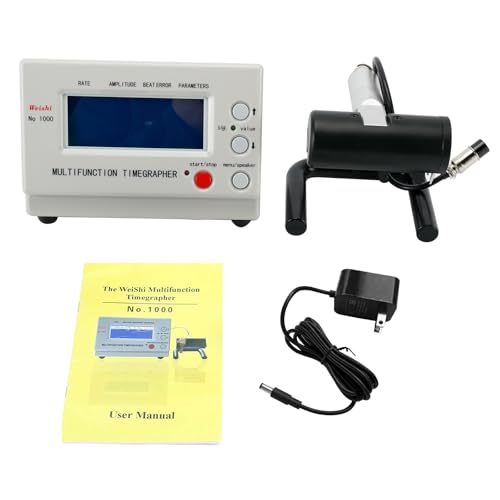
- Measures rate, amplitude, and beat error
- Six positions with adjustable sampling periods
- 3-inch LCD with automatic signal adjustment
Best For: Mechanical watch collectors wanting flexible routine testing
Professional Diagnostic Pick
MechanBINGOX 6-Position Timegrapher

- Measures rate, amplitude, beat error, and curves
- Tests six mechanical-watch positions
- Supports common 18,000-36,000 BPH frequencies
Best For: Watchmakers and collectors performing detailed movement checks
Space-Saving Classic
NO.1000 Multifunction Timegrapher

- Compact 6.77 x 1.57 x 4.49-inch design
- Tests almost all mechanical watches
- Corded tester for watchmakers and collectors
Best For: Bench setups where a small footprint is important
Amateur-Friendly USB-C Option

- Measures six key timing and movement values
- Includes USB Type-C data cable
- Noise-reduced housing with hard-plastic construction
Best For: Amateurs wanting broad measurement functions
Coaxial-Ready Pick

- Larger LCD screen than the NO.1000
- Works with mechanical and coaxial watches
- 100V–240V power with regional plug options
Best For: Collectors and watchmakers wanting clear display and coaxial support
Pocket-Watch Option

- Listed for pocket-watch compatibility
- 2-inch listed length
- Aftermarket design made to factory specifications
Best For: Pocket-watch owners who will verify fit before purchase
Display Upgrade Pick

- High-resolution color screen with dual traces
- Measures rate, amplitude, and beat error
- Includes sensor, US adapter, manual, and cloth
Best For: Users wanting detailed diagnostics for mechanical and coaxial watches
Large-Screen Workshop Choice

- Large high-resolution color LCD screen
- Shows live rate, amplitude, and beat error
- Includes sensor, US adapter, and manual
Best For: Mechanical-watch workbenches needing easy-to-read readings
Precision Portable Pick
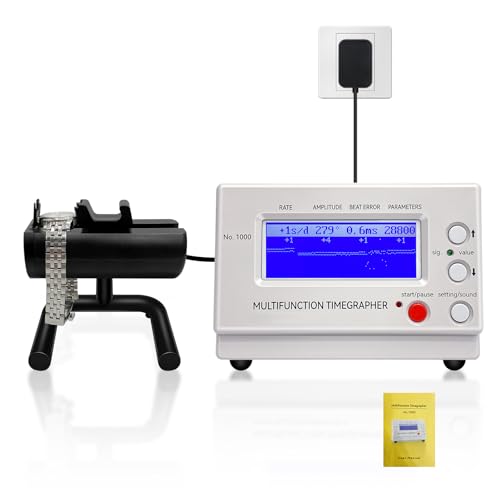
- Measures rate, amplitude, polarity, and lift angle
- Supports adjustable sampling and directional tests
- Compact design with 100V–240V input
Best For: Portable mechanical-watch diagnosis and calibration
Accessible Choice – YaeTek NO.1000 Timegrapher
For shoppers comparing compact watch timing machines, the YaeTek NO.1000 offers a straightforward way to check mechanical watch performance. It calculates rate, amplitude, and beat error through its microphone stand, with results shown on a 3-inch LCD screen.
Best For: Mechanical watch collectors who want adjustable testing positions and selectable sampling periods.
Pros:
- Measures rate, amplitude, and beat error automatically.
- Supports six testing positions.
- Offers sampling periods from 2 to 60 seconds.
- Uses a 110V-220V US plug and displays readings in real time.
Cons:
- The listed amplitude level is limited to 275-315.
- Its 1.37 kg weight may be less convenient for frequent transport.
The automatic signal adjustment and moving timing lines make this a practical option for routine mechanical-watch checks, especially when you want more control over test duration and position.
Professional Diagnostic Pick – MechanBINGOX 6-Position Timegrapher
Among compact watch timing machines, this professional timegrapher is built for detailed mechanical-watch diagnostics. It displays rate, amplitude, beat error, and timing curves in real time while supporting six watch positions and several common beat frequencies.
Best For: Watchmakers, repair shops, collectors, and enthusiasts evaluating movement consistency across orientations.
Pros:
- Provides real-time rate, amplitude, beat-error, and timing-curve readings.
- Supports dial-up, dial-down, and four crown-position tests.
- Compatible with 18,000, 21,600, 28,800, and 36,000 BPH mechanical movements.
- Uses a clear LCD display for easy-to-read diagnostics.
Cons:
- It is designed for mechanical and automatic watches, not quartz watches.
- The supplied details do not specify physical dimensions.
Its broad beat-frequency support and six-position analysis make it the most diagnostic-focused choice in this group for users who need more than a basic rate check.
Space-Saving Classic – NO.1000 Multifunction Timegrapher
If you want compact watch timing machines for a dedicated bench or collection workspace, this NO.1000 timegrapher has a particularly space-conscious design. Its listed dimensions are 6.77 x 1.57 x 4.49 inches, and it is intended for testing almost all mechanical watches.
Best For: Professional watchmakers and collectors seeking a compact, corded mechanical-watch tester.
Pros:
- Compact modern design with listed dimensions of 6.77 x 1.57 x 4.49 inches.
- Designed for almost all mechanical watches.
- Suitable for both professional watchmakers and collectors.
- Uses corded electric power with a minimum operating voltage of 100 volts.
Cons:
- The supplied notes do not list amplitude or beat-error measurement details.
- It requires corded electric operation.
This is a sensible choice when footprint matters most and your primary requirement is a compact timing tester for mechanical watches rather than a feature-heavy diagnostic platform.
Amateur-Friendly USB-C Option – Wristwatch USB-C Timegrapher
DBEIXIWEI Watch Timegrapher with USB Type-C Data Cable Wristwatch Timing Machine Calibration Tool
Check Price On AmazonThis USB-C timegrapher is a practical contender among compact watch timing machines for amateur users. It measures rate, amplitude, beat error, frequency, lift angle, and waveform, while its enclosed housing includes noise reduction and sound insulation features.
Best For: Amateur watch users who want broad measurement functions and USB Type-C connectivity.
Pros:
- Measures rate, amplitude, beat error, frequency, lift angle, and waveform.
- Includes a USB Type-C data cable.
- Uses a rugged hard-plastic housing.
- Features an enclosed noise-reduction and sound-insulation cavity.
Cons:
- The supplied notes do not specify physical dimensions.
- It has a limited warranty.
- Water resistance is not provided.
With its wide measurement set and amateur-oriented design, this model is appealing for users who want to explore multiple movement readings without choosing a more specialized professional analyzer.
Coaxial-Ready Pick – NO.1900 LCD Timegrapher
OTOOLWORLD New Coaxial MTG Watch Tester Timing Multifunction Timegrapher LCD Screen NO.1900
Check Price On AmazonFor shoppers comparing compact watch timing machines, the NO.1900 combines a larger LCD screen with multifunction timing analysis. Its support for mechanical and coaxial watches makes it a practical option for watch collectors and professional watchmakers.
Best For: Users who want a larger display and coaxial-watch compatibility.
Pros:
- Larger LCD screen than the NO.1000 for easier viewing.
- Designed for almost all mechanical watches and works especially well with coaxial watches.
- Supports 100V–240V power and includes exchangeable regional plug options.
Cons:
- It is corded electric rather than battery powered.
- The supplied notes do not specify detailed measurement ranges or included accessories.
The NO.1900 is a sensible choice when clear viewing and broad mechanical-watch compatibility matter more than portability. Its worldwide voltage support also helps users who need flexible setup options.
Pocket-Watch Option – Ewatchparts 1000 Timegrapher
Ewatchparts Watch Timing Machine Multifunction Timegrapher 1000 Compatible With Pocket Watch
Check Price On AmazonAmong compact watch timing machines, this Ewatchparts multifunction timegrapher is specifically listed as compatible with pocket watches. Buyers should verify their watch model and measurements before purchasing, since fit and compatibility details are important.
Best For: Pocket-watch owners seeking an aftermarket timing-machine option.
Pros:
- Listed as compatible with pocket watches.
- Compact listed length of 2 inches.
- Aftermarket product made to original factory specifications.
Cons:
- The supplied notes provide limited technical information about timing measurements.
- Compatibility, size, and model should be checked carefully before ordering.
- It is described as an aftermarket or generic product.
This option is most appealing when pocket-watch compatibility is the priority. Because the available specifications are limited, careful measurement and model verification are essential before buying.
Display Upgrade Pick – TICFROG NO.1900 Timegrapher
The TICFROG NO.1900 is one of the more feature-focused compact watch timing machines, pairing a high-resolution color screen with live mechanical-watch measurements. Its dual trace display is designed to make beat-error adjustment and troubleshooting easier.
Best For: Hobbyists, collectors, and professionals who want detailed on-screen timing information.
Pros:
- Color display shows separate yellow and light-blue traces for entrance and exit pings.
- Measures rate deviation, amplitude, and beat error while displaying beat number and lift angle.
- Supports one to six measuring positions and 100V–240V AC power.
- Includes a sensor, US adapter, user manual, and cleaning cloth.
Cons:
- It is intended for mechanical and coaxial watches rather than general quartz-watch testing.
- Its corded AC setup may be less convenient for portable use.
- The included power adapter is specifically listed as a US adapter.
Choose this model when display clarity and diagnostic detail are central to your buying decision. The stated measurement ranges and dual-trace view give it a stronger feature set for calibration and troubleshooting.
USB-Ready Calibration Pick – Compact Multifunction Timegrapher
If you need compact watch timing machines for a space-conscious workbench, this lightweight multifunction timegrapher offers a practical feature set. It measures daily rate, amplitude, beat error, frequency, polarization, oscillation, and waveform, while its adjustable sliding jaws help secure different watch dial sizes.
Best For: Hobbyists and technicians who want a small timing machine with adjustable positioning and computer data transfer.
Pros:
- Measures multiple mechanical-watch timing metrics, including daily rate, amplitude, and beat error.
- USB/RS232 data transfer supports use with tablets, laptops, and desktops.
- Removable sliding jaws accommodate various dial sizes.
- Compact 3.94 x 2.36 x 1.97-inch design weighs about 3.99 ounces.
Cons:
- The supplied notes do not specify a display size or included accessories.
- Quartz-watch compatibility is not stated.
This is a particularly portable option for users who value data connectivity and adjustable watch positioning. The illuminated power indicator adds a simple operational cue, but buyers wanting a larger integrated screen may prefer another model.
Large-Screen Workshop Choice – SWANSOFT No.1900 Timegrapher
Among compact watch timing machines, the SWANSOFT No.1900 stands out for its larger, high-resolution color LCD screen. It displays live rate, amplitude, beat error, beat, and lift angle readings, giving watchmakers and collectors an easy-to-read overview of a mechanical movement’s performance.
Best For: Watchmakers, technicians, and collectors who prioritize a larger backlit display and straightforward operation.
Pros:
- Large, high-resolution color LCD screen is designed for easier reading.
- Displays live rate, amplitude, beat error, beat, and lift angle data.
- Includes a timegrapher sensor, US adapter, and professional user manual.
- Backlit screen and intuitive interface support practical bench use.
Cons:
- Designed only for mechanical movement watches; it does not support quartz movements.
- At 1.62 kg, it is less lightweight than the other listed options.
- The supplied notes identify a US adapter, which may require an adapter elsewhere.
The No.1900 is a sensible choice when screen visibility matters more than minimum weight. Its included sensor and manual make it ready for a dedicated workbench, while mechanical-only compatibility limits its versatility.
Precision Portable Pick – Timegrapher No.1000
This Timegrapher No.1000 combines compact portability with detailed mechanical-watch testing. It measures daily rate, beat amplitude, polarity, beat, lift angle, and period, and adds adjustable sampling, directional measurements, and automatic standard-beat detection for more flexible diagnosis.
Best For: Enthusiasts, makers, and technicians seeking a portable, high-resolution tester with broad measurement controls.
Pros:
- Measures key timing values with a stated daily-rate resolution of 0.1 seconds per day.
- Supports 2–60-second sampling periods and 1–6 directional measurements.
- Compact design, 100V–240V input, and lightweight construction support portability.
- Stable zinc-alloy microphone base and aluminum rotating shaft are designed for reliable sensing.
Cons:
- The supplied notes do not specify support for quartz movements.
- The 192 x 64-pixel display is functional but smaller than the No.1900’s larger-screen design.
- Its extensive settings may take more time to learn than a basic tester.
With broad measurement ranges and flexible sampling controls, this model is a strong fit for users who want more than a basic rate check. Its compact build and wide-voltage input also make it practical for moving between work areas.
How We Picked These Compact Watch Timing Machines
We focused on compact timegraphers designed to test mechanical and automatic watches while displaying the measurements most useful for regulation and diagnosis. The selection includes multifunction testers with LCD screens, acoustic pickup rails, USB Type-C connectivity, and compatibility with wristwatches or pocket watches.
Because specifications and included accessories can vary by seller, verify the current listing before buying. Pay particular attention to the stated measurement range, lift-angle settings, pickup design, power requirements, and software or data-export support.
Quick Comparison
| Feature | Why It Matters |
|---|---|
| Daily rate | Shows whether the watch is running fast or slow. |
| Beat error | Helps identify imbalance between the tick and tock. |
| Amplitude | Provides a useful indication of the movement’s energy and condition. |
| Multiple positions | Allows comparisons that better reflect real-world performance. |
| USB or data support | Can simplify power, updates, recording, or analysis, depending on the model. |
Key Buying Factors for Compact Watch Timing Machines
Measurement Accuracy and Readability
Choose a clear display that shows rate, amplitude, beat error, and beat frequency simultaneously when possible. A stable reading is more useful than a long list of nominal features, especially when making small regulator adjustments.
Pickup and Watch Compatibility
An acoustic sensor or pickup rail should hold the watch securely and detect the movement consistently. Check whether the design accommodates different case sizes, thick cases, unusual lugs, and pocket watches if those are part of your work.
Lift-Angle and Beat Settings
Correct lift-angle and beat-frequency settings are essential for meaningful amplitude and rate readings. Models with adjustable settings are more versatile across movements, while simpler units may be easier for beginners.
Power, Portability, and Workflow
For a bench setup, prioritize a stable stand, readable screen, and convenient controls. If you travel to clients or work in limited space, consider a lightweight unit with USB Type-C power or a compact footprint. Confirm whether a power adapter or cable is included.
Who Should Buy Which Compact Watch Timing Machines?
Beginners and casual collectors: Choose an easy-to-operate multifunction timegrapher with a readable LCD and straightforward controls.
Hobbyists regulating several watches: Look for adjustable beat settings, reliable pickup performance, and position testing so you can compare results consistently.
Watchmakers and repair professionals: Favor models with stable readings, broad movement compatibility, durable construction, and a workflow that supports repeated testing throughout the day.
Pocket-watch owners: Confirm that the sensor and rail can accommodate larger cases before ordering. Compatibility should take priority over a lower price.