Finding the right digital watch timing machine depends on the watches you service, the measurements you need, and how much control you want over calibration and repair tasks.
This roundup includes multifunction timegraphers, quartz testers, demagnetizers, and practical watch tools suited to hobbyists, collectors, and working watchmakers.
Best 10 Digital Watch Timing Machines Picks for 2026
Workshop Pick
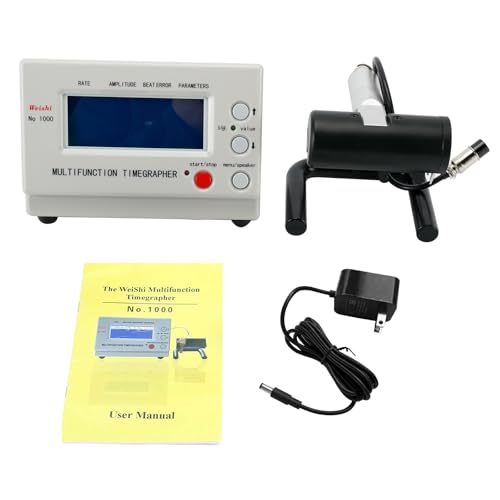
- Measures rate, amplitude, and beat error
- Six testing positions and adjustable sampling
- LCD display with visual tick-tock trace
Best For: Mechanical-watch collectors and hobbyist watch benches
Everyday Timing Pick

- 1/100-second stopwatch with split timing
- Eight-digit calculator and dual time
- Auto calendar through 2079
Best For: Everyday wearers needing stopwatch and calculator functions
Calibration Bench Pick
No.1000 Mechanical Watch Timegrapher

- Displays five key mechanical-watch readings
- Automatic beat settings from 12,000 to 43,200
- Includes sensor, US adapter, manual, and cloth
Best For: Amateur watchmakers and technicians
Professional Diagnostic Pick
YaeTek No.1900 Digital Timegrapher

- Displays rate, amplitude, and beat error
- Larger LCD screen for easier viewing
- Works with most mechanical and coaxial watches
Best For: Watchmakers and collectors testing mechanical watch accuracy
Pocket Watch Testing Option

- Designed for compatible pocket watches
- Multifunction aftermarket timegrapher
- Verify model and size before purchase
Best For: Buyers testing appropriately sized pocket watches
Compact Multi-Tester
Quartz, Battery & Demagnetizer

- Tests quartz movements and watch batteries
- Includes adjustable demagnetization
- Compact battery-powered design
Best For: Basic watch repair and portable diagnostics
Workshop 3-in-1
Battery, Quartz & Demagnetizer

- Tests batteries and quartz movements
- Demagnetizes mechanical watches with an on/off switch
- Rugged, compact, and portable
Best For: Routine home and workshop watch repair
Workshop Pick – YaeTek No.1000 Timegrapher
For collectors who need digital watch timing machines for routine mechanical-watch checks, the YaeTek No.1000 provides live measurements in a compact desktop format. It automatically calculates rate, amplitude, and beat error, while the LCD shows moving lines that visually represent the watch’s tick-tock.
Best For: Mechanical-watch collectors who want adjustable testing positions and selectable sampling periods.
Pros:
- Displays rate, amplitude, and beat error in real time.
- Offers six adjustable testing positions.
- Supports sampling periods from 2 to 60 seconds.
- Automatically adjusts the signal level for different watches.
Cons:
- Designed for mechanical-watch testing rather than general timekeeping.
- The supplied notes specify a 110V–220V US plug, which may limit use in some regions.
Its LCD readout, visual trace, and flexible sampling options make this a practical entry-level timing machine for hobbyist watch benches.
Everyday Timing Pick – Casio CA53W Data Bank Watch
The Casio CA53W is a wristwatch rather than one of the digital watch timing machines used to test mechanical movements, but its 1/100-second stopwatch makes it useful for everyday timing tasks. It also combines an eight-digit calculator, dual time, alarm, and an auto calendar in a lightweight resin case.
Best For: Wearers who want a compact digital watch with stopwatch and calculator functions.
Pros:
- Includes a 1/100-second stopwatch with split-time modes.
- Built-in eight-digit calculator supports basic arithmetic.
- Offers dual time and an auto calendar programmed through 2079.
- Water-resistant design and a 5-year battery are listed.
Cons:
- It is a quartz wristwatch, not a watch movement timing tester.
- The calculator and display are suited to basic functions rather than advanced data entry.
Choose the CA53W when you need timing on your wrist, not calibration equipment on a workbench. Its extra calculator and data-bank-style features give it a distinct practical appeal.
Calibration Bench Pick – No.1000 Mechanical Watch Timegrapher
This No.1000 is a focused choice among digital watch timing machines for watchmakers and technicians. Its digital display reports rate, amplitude, beat error, beat, and lift angle, while automatic beat settings from 12,000 to 43,200 support testing a broad range of mechanical movements.
Best For: Amateur watchmakers, technicians, and owners who need a dedicated mechanical-watch calibration tool.
Pros:
- Shows rate, amplitude, beat error, beat, and lift angle.
- Supports automatic beat settings from 12,000 to 43,200 plus manual settings.
- Includes the timegrapher, sensor, US adapter, English manual, and cleaning cloth.
- AC-powered design suits a stationary watchmaking desk.
Cons:
- It is intended for mechanical watches and is not a general-purpose wristwatch.
- The supplied notes identify a US adapter, so regional power compatibility should be checked.
With more displayed measurements and a broad beat-rate range, this model is the stronger fit for users who want detailed movement analysis and a ready-to-use package.
Rugged Digital Pick – Casio AE-1600H Large-Face Watch
The Casio AE-1600H is another wristwatch rather than a movement-testing machine, so it is not a substitute for digital watch timing machines. It is, however, built for convenient timing and daily wear, with a 1/100-second stopwatch, auto-repeat timer, dual time, five alarms, and a front-button LED illuminator.
Best For: Users who want a highly readable, water-resistant digital watch with long battery life and multiple timers.
Pros:
- Large face and oversized numerals support quick reading.
- Offers 100-meter water resistance and a resin case and band.
- Includes dual time, a 1/100-second stopwatch, and an auto-repeat timer.
- Lists a 10-year CR2032 battery life and front-button LED afterglow.
Cons:
- It is a quartz wristwatch, not a mechanical-watch timing instrument.
- The 54.1mm case may feel large on smaller wrists.
For rugged everyday timing, the AE-1600H emphasizes visibility, water resistance, and low maintenance. Choose it for wrist-based functions rather than watch repair or calibration.
Professional Diagnostic Pick – YaeTek No.1900 Digital Timegrapher
For shoppers comparing digital watch timing machines, the YaeTek No.1900 is a multifunction tester designed to evaluate mechanical watch performance. Its larger LCD screen displays rate, amplitude, beat error, beats per hour, and lift angle in one compact unit.
Best For: Watchmakers, collectors, and beginners regulating vintage, modern, or coaxial mechanical watches.
Pros:
- Measures rate, amplitude, beat error, beats per hour, and lift angle.
- Larger LCD screen than the No.1000 for improved visibility.
- Compatible with almost all mechanical watches, including coaxial movements.
- Includes a 110–220V US plug and weighs 3.06 pounds.
Cons:
- Designed for mechanical watch diagnostics rather than everyday timekeeping.
- Its dimensions and weight make it less portable than smaller testing tools.
The No.1900 stands out when readable measurements and broad mechanical-watch compatibility matter more than a minimal footprint. It is a practical all-in-one option for regulation and accuracy checks.
Everyday Timing Wearable – Casio W735H Digital Sports Watch
Although it is a wristwatch rather than a bench tester, the Casio W735H is a useful choice for shoppers seeking digital watch timing machines for everyday stopwatch and countdown tasks. It combines 1/100-second timing with a vibration alert, dual time, and a bright LED display.
Best For: Runners, coaches, swimmers, travelers, and anyone who needs portable timing functions.
Pros:
- 1/100-second stopwatch supports elapsed, split, and first- and second-place timing.
- 24-hour countdown timer includes auto-repeat for interval routines.
- Vibration alarm provides discreet alerts in quiet or noisy settings.
- Offers 100-meter water resistance, a 10-year battery, and Super Illuminator LED lighting.
Cons:
- It is not a mechanical watch timegrapher or watch regulation tool.
- The 44-millimeter case and 15-millimeter thickness may feel substantial on smaller wrists.
The W735H is best understood as a rugged timing watch for activities and schedules, not as equipment for diagnosing watch movements. Its long battery life and water resistance make it particularly practical for active use.
Pocket Watch Testing Option – Ewatchparts Timegrapher 1000
Ewatchparts Watch Timing Machine Multifunction Timegrapher 1000 Compatible With Pocket Watch
Check Price On AmazonAmong digital watch timing machines, the Ewatchparts Timegrapher 1000 is presented as an aftermarket multifunction tester compatible with pocket watches. Because watch parts and accessories are model- and size-specific, verify your pocket watch’s requirements before purchasing.
Best For: Buyers seeking a generic Timegrapher 1000-style tester for compatible pocket watches.
Pros:
- Designed for compatibility with pocket watches.
- Multifunction timegrapher format supports watch-testing applications.
- Aftermarket product made to original factory specifications.
Cons:
- The supplied details provide limited information about displayed measurements and operating features.
- Compatibility and sizing must be checked carefully before ordering.
- It is an aftermarket/generic product rather than a stated original-brand unit.
This option may suit buyers focused on pocket-watch compatibility, but the limited specifications make pre-purchase verification especially important. Confirm the model and size before relying on it for a particular watch.
Compact Multi-Tester – Quartz, Battery & Demagnetizer
This compact option for digital watch timing machines combines quartz-movement checking, battery testing, and adjustable demagnetization. It is designed for quick diagnostic and maintenance tasks without opening a watch case for pulse-based battery testing.
Best For: Watchmakers and repair users who need several basic testing functions in one portable tool.
Pros:
- Combines quartz testing, battery testing, pulse testing, and demagnetization.
- Adjustable demagnetization speed provides more control during use.
- Compact, lightweight design runs on two AA batteries.
Cons:
- AA batteries are not included.
- The supplied notes do not specify measurement ranges or display details.
This is a practical multifunction choice when portability and broad basic functionality matter more than advanced timing data or computer connectivity.
Advanced Mechanical Analyzer – USB/RS232 Timegrapher
This timegrapher is the most data-focused option among these digital watch timing machines. It measures daily rate, amplitude, and beat error while adding waveform and frequency-related analysis, with USB/RS232 transfer for computer-based workflows.
Best For: Mechanical-watch users who want detailed calibration data and the ability to transfer results to a computer.
Pros:
- Displays daily rate, amplitude, beat error, waveform, and related signal data.
- Supports PC data transfer through USB/RS232 connectivity.
- Adjustable sliding jaws accommodate various watch dial sizes.
- Indicator light makes powered-on status easy to monitor.
Cons:
- Its feature set is geared toward mechanical-watch calibration rather than general battery testing.
- The supplied notes do not specify included cables or software.
Choose this model if calibration analysis and data transfer are priorities; its adjustable holder also makes it more flexible for securing different watch sizes.
Workshop 3-in-1 – Battery, Quartz & Demagnetizer
This 3-in-1 tool gives digital watch timing machines shoppers a compact maintenance option for battery checks, quartz diagnostics, and mechanical-watch demagnetization. Its portable construction is suited to home workbenches and repair toolboxes.
Best For: Home users and repairers who want one rugged, portable tool for common watch troubleshooting tasks.
Pros:
- Combines battery testing, quartz diagnostics, and demagnetization.
- Responsive sensor provides quick button-battery voltage checks.
- On/off control supports controlled demagnetization.
- Compact, lightweight design is easy to store and carry.
Cons:
- It is a general multifunction tool rather than a dedicated advanced timegrapher.
- The supplied notes do not list measurement ranges or included accessories.
This model is a sensible space-saving pick for routine diagnostics and demagnetization, especially when portability and a simple three-function design are more important than PC data analysis.
How We Picked These Digital Watch Timing Machines
We selected products to cover the most common watchmaking needs rather than focusing on one type of tester. The list includes dedicated mechanical timegraphers, multifunction units with quartz or battery functions, demagnetizers, and compatible tools for wristwatches or pocket watches.
We also considered display readability, stated measurement functions, acoustic pickup design, portability, ease of operation, and suitability for beginners. Because features and included accessories can vary by listing, confirm the specifications, supported movements, and package contents before ordering.
Quick Comparison
| Best For | What to Look For |
|---|---|
| Mechanical watch regulation | Rate, amplitude, beat error, lift-angle settings, and a stable pickup |
| Quartz troubleshooting | Pulse detection, battery testing, and movement compatibility |
| Demagnetizing | A dedicated demagnetizer mode with simple, controlled operation |
| Multiple repair tasks | A multifunction design that combines testing, timing, and battery functions |
| Occasional home use | Clear controls, compact construction, and straightforward setup |
Key Buying Factors for Digital Watch Timing Machines
Measurement Functions
For mechanical watches, prioritize daily rate, amplitude, beat error, beat rate, and timing graphs. These readings help identify whether a movement needs regulation or further inspection. If you work on quartz watches, look for pulse testing and battery-related functions instead of paying extra for mechanical measurements you will not use.
Pickup and Compatibility
An acoustic pickup or microphone rail should hold the watch securely and detect the movement consistently. Check whether the unit supports your watch sizes, pocket watches, and movement types. Some testers require a quiet environment or careful positioning for reliable readings.
Controls and Display
A readable LCD and uncomplicated controls make repeated testing faster. Adjustable parameters such as beat rate and lift angle can be valuable for experienced users, while beginners may benefit from automatic detection and fewer manual settings.
Build, Accessories, and Support
Compare the included pickup, cables, adapters, instructions, and power requirements. A basic tester can be useful, but missing accessories may add cost later. Also check return coverage and seller support, particularly for electronic tools used in professional repair.
Who Should Buy Which Digital Watch Timing Machines?
Choose a dedicated timegrapher if your main goal is regulating mechanical wristwatches and you want detailed timing data. A multifunction tester is a better fit for a repair bench handling mechanical, quartz, and battery-related jobs. Select a model with demagnetization when magnetic interference is part of your troubleshooting routine.
For hobbyists, collectors, and occasional servicing, favor a compact, easy-to-use machine with clear readings over advanced controls you may rarely adjust. Professional watchmakers should prioritize repeatable measurements, broad movement compatibility, durable construction, and the accessories needed for daily bench work.