A reliable timegrapher can make mechanical watch adjustment far easier by showing rate, beat error, amplitude, and beat frequency in seconds. The challenge is finding useful readings and practical controls without exceeding a $200 budget.
We’ve gathered 10 budget-friendly timing machines and related watch-testing tools, including multifunction timegraphers, calibration testers, and specialized devices. Use the guide below to match features, usability, and limitations to your repair or hobbyist needs.
Best 10 Watch Timing Machine Under 200 Picks for 2026
Top Mechanical Watch Pick
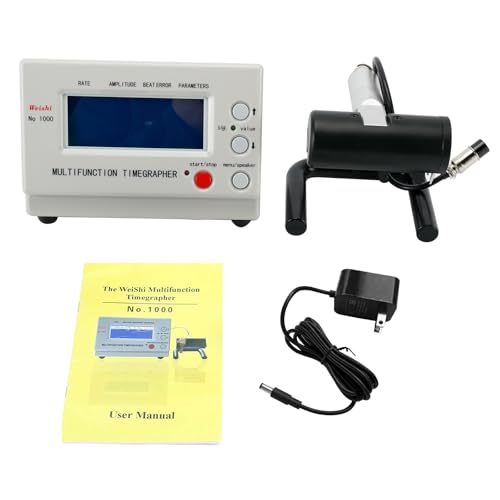
- Measures rate, amplitude, and beat error
- Six testing positions with LCD display
- Sampling options from 2 to 60 seconds
Best For: Mechanical-watch collectors and hobbyists
Workplace Timekeeping Alternative

- Automatically feeds and aligns time cards
- Includes 50 cards and an ink ribbon
- Prints attendance records in two colors
Best For: Small-office paper attendance tracking
Repairer-Friendly Pick

- Measures rate deviation, amplitude, and beat error
- Shows a frequency diagram on the LCD
- Supports selectable 2-to-60-second sampling
Best For: Watch repairers and timing enthusiasts
Automatic Watch to Test

- NH35A Japanese automatic movement
- Exhibition case back with 200 m water resistance
- 40 mm stainless-steel case and silicone band
Best For: Automatic-watch buyers and potential timegrapher test subjects
PC-Ready Timegrapher

- Measures rate, amplitude, beat error, frequency, and waveform
- Connects to Windows PCs and Android phones
- Noise-reduced sensor cavity with hard-plastic housing
Best For: DIY watch enthusiasts and hobbyist repair benches
Dual-Watch Pressure Tester

- Tests two watches at once
- Transparent chamber supports visual inspection
- Compact manual design for mechanical and quartz watches
Best For: Post-service water-resistance checks
Compact Multi-Tester
Quartz, Battery & Demagnetization Tester

- Combines four basic watch-testing functions
- Adjustable demagnetization speed
- Compact, battery-powered design
Best For: Basic quartz, battery, pulse, and demagnetization checks
Full Timing Analysis

- Measures rate, amplitude, beat error, and beat number
- Offers six positions and adjustable sampling periods
- Includes microphone, adapter, and English manual
Best For: Detailed mechanical-watch timing analysis at a bench
Sound-Sensing Calibrator

- High-sensitivity vibration sensor
- Sound-insulated cavity reduces unwanted noise
- Lightweight 0.13 kg construction
Best For: Compact sound-based checks of mechanical watches
Top Mechanical Watch Pick – YaeTek No.1000 Timegrapher
If you need a watch timing machine under 200 for checking mechanical watches, the YaeTek No.1000 provides useful timing measurements on an LCD screen. It automatically calculates rate, amplitude, and beat error while offering multiple test positions and selectable sampling periods.
Best For: Mechanical-watch collectors and hobbyists who want an accessible multifunction timegrapher.
Pros:
- Displays rate, amplitude, and beat error in real time.
- Offers six adjustable testing positions.
- Supports sampling periods from 2 to 60 seconds.
- Uses automatic signal-level adjustment for different watches.
Cons:
- The supplied specifications list an amplitude level between 275 and 315, which may not suit every testing need.
- At 1.37 kg, it is less convenient to move than a compact handheld tool.
With its LCD visualization, US-compatible 110V-220V plug, and adjustable sampling options, this is a practical choice for routine mechanical-watch checks. Verify that its measurement range and format match your watches before buying.
Workplace Timekeeping Alternative – TooCust Employee Time Clock
The TooCust is not a watch timing machine under 200; it is an employee punch clock for small businesses. It automatically feeds and aligns compatible time cards, records attendance, and uses two-color printing to distinguish on-time punches from late or early activity.
Best For: Small offices or home offices that need paper-based employee attendance tracking.
Pros:
- Includes 50 time cards, two security keys, and an ink ribbon.
- Automatically feeds and aligns cards.
- Supports weekly, biweekly, and monthly pay modes.
- Two-color printing helps identify attendance exceptions.
Cons:
- It does not test or regulate mechanical watches.
- It is designed for 7.1-by-2.4-inch time cards.
- It is an indoor, corded-electric tabletop unit.
This product is only relevant if “time machine” refers to employee attendance equipment rather than watch servicing. For mechanical-watch timing, choose one of the dedicated timegraphers instead.
Repairer-Friendly Pick – LANRU No.1000 Timegrapher
For shoppers seeking a watch timing machine under 200, the LANRU No.1000 offers the core measurements needed to evaluate a mechanical watch. It reports rate deviation, amplitude, and beat error in real time, while its LCD can display the watch’s frequency diagram.
Best For: Watch repairers and hobbyists who want selectable sampling and timing-graph feedback.
Pros:
- Automatically calculates rate deviation, amplitude, and beat error.
- Provides sampling choices from 2 to 60 seconds.
- Displays a frequency diagram on the LCD screen.
- Automatically adjusts signal level for different watches.
Cons:
- Special beat rates may require manual selection.
- The supplied notes do not specify power-plug compatibility or testing positions.
- At 3.28 pounds, it is not especially lightweight.
The LANRU stands out for combining automatic measurements with frequency-graph viewing and manual support for special beat rates. It is a strong candidate when diagnostic display features matter more than portability.
Automatic Watch to Test – Invicta Pro Diver 23678
Invicta Men's Pro Diver Automatic Watch with Silicone Band, Black (Model 23678)
Check Price On AmazonThe Invicta Pro Diver is not a watch timing machine under 200, but it is the type of automatic mechanical watch that a timegrapher can evaluate. Its NH35A Japanese automatic movement, exhibition case back, and 200-meter water resistance make it a notable watch option for collectors and divers.
Best For: Buyers seeking an automatic diver-style watch with a visible movement and substantial water resistance.
Pros:
- Uses an NH35A Japanese automatic movement with 24 jewels.
- Features an exhibition case back.
- Includes a screw-down crown and unidirectional stainless-steel bezel.
- Rated for 200-meter water resistance.
Cons:
- It is a watch, not a timing machine or timegrapher.
- The 14 mm case thickness may feel substantial on the wrist.
- It uses mineral crystal rather than a higher-end crystal specification.
If you are building a testing setup, this automatic watch could be a subject for a compatible timegrapher, but it cannot perform timing measurements itself. Consider it only as a comparison or test-watch option, not as the equipment purchase.
PC-Ready Timegrapher – Watch Movement Timing Tester
If you’re looking for a watch timing machine under 200 for at-home mechanical watch work, this PC-ready timegrapher offers useful measurements without an overly complicated setup. It can connect to Windows computers and Android phones for timing analysis.
Best For: Watch enthusiasts and DIY users who want a computer-connected tool for checking and calibrating mechanical watches.
Pros:
- Measures daily rate, beat error, amplitude, frequency, waveform, and related timing data.
- Works with Windows XP, 7, 8, and 10 computers, plus Android phones.
- Uses a vibration sensor, integrated amplifier circuit, and enclosed noise-reduction cavity.
- Hard-plastic housing is designed for regular workshop or hobby use.
Cons:
- Computer or Android connectivity is needed for the supported digital workflow.
- Designed for amateur use, so buyers seeking advanced professional equipment may want a more specialized instrument.
This is a practical choice when connectivity and a broad set of timing measurements matter. Its anti-magnetization design and enclosed sensor area add useful features for routine mechanical-watch testing.
Dual-Watch Pressure Tester – 10-Bar Waterproofing Tool
Although it is not a timing machine, this manual pressure tester can complement a watch timing machine under 200 by checking case water resistance after watch servicing. Its transparent chamber and dual-watch capacity make inspection straightforward.
Best For: Watch repair users who need a compact manual tool for checking the water resistance of mechanical and quartz watches.
Pros:
- Can test two watches at the same time for improved workflow efficiency.
- Transparent glass cylinder helps reveal where a case may not be waterproof.
- Fits watches up to 2.6 inches in diameter and 2.8 inches in height.
- Compact aluminum-and-glass construction measures 9.5 by 5.5 by 10.6 inches.
Cons:
- Tests water resistance rather than mechanical timing performance.
- Uses a manual analog pressure system, not an electronic display.
- Its listed air-pressure test range is 0.3–0.6 bar, so buyers should match it to their testing needs.
Choose this model as a companion tool rather than a substitute for a timegrapher. The dual-watch layout, visible chamber, and manual operation suit small repair spaces and routine case checks.
Adjustable USB Timegrapher – Mechanical Watch Calibrator
This adjustable timegrapher is a strong option for shoppers comparing a watch timing machine under 200 for mechanical watch calibration. It combines timing measurements, an acoustic pickup rail, adjustable clips, and USB/RS232 data transfer.
Best For: Hobbyists and repair users who want flexible watch positioning and a computer-connected calibration workflow.
Pros:
- Measures daily rate, amplitude, beat error, frequency, signal value, and waveform.
- Adjustable sliding jaws accommodate different watch dial sizes.
- Supports data transfer to tablets, laptops, and desktops through USB/RS232 connectivity.
- Red indicator light makes power status easy to monitor.
Cons:
- Its data-transfer workflow requires connection to a compatible computer or tablet.
- The supplied details do not specify supported operating systems or included software.
- Its broad adjustment and analysis features may be more than casual users need.
With adjustable clips and multiple timing displays, this model is suited to users who want repeatable positioning and more detailed analysis. Confirm the computer and software requirements before buying.
Compact Multi-Tester – Quartz, Battery & Demagnetization Tester
If you need a watch timing machine under 200 for basic bench testing, this compact battery-powered tool combines quartz checking, battery testing, pulse testing, and demagnetization in one unit. It is aimed at watch repairers who want several quick diagnostic functions without a larger timegrapher.
Best For: Watchmakers and repair workers handling quartz watches, batteries, and demagnetization tasks.
Pros:
- Combines quartz, battery, pulse, and demagnetization functions.
- Adjustable demagnetization speed adds flexibility.
- Compact 151 g design is convenient for a repair bench.
Cons:
- Two AA batteries are required and are not included.
- It does not provide the rate, amplitude, and beat-error readings of a dedicated timegrapher.
This is a practical multifunction tester rather than a full mechanical-watch timing analyzer. Choose it when compact size and battery or quartz diagnostics matter more than detailed timing data.
Full Timing Analysis – WEISHI No. 1000 Timegrapher
For shoppers comparing a watch timing machine under 200, the WEISHI No. 1000 is the most measurement-focused option here. It automatically calculates rate, amplitude, beat error, and beat number, while offering selectable sampling periods and six testing positions for mechanical-watch analysis.
Best For: Watchmakers and serious hobbyists who need detailed mechanical-watch timing measurements.
Pros:
- Displays rate, amplitude, beat error, and beat number in real time.
- Supports six testing positions and multiple sampling periods from 2 to 60 seconds.
- Automatically recognizes many common beat rates and includes manual beat-rate selection.
Cons:
- At 1.7 kg, it is less portable than compact testers.
- It uses a 90–220 V power supply rather than battery power.
- No printer connection is included.
With a stated rate range of ±999 seconds per day and amplitude measurement from 100° to 360°, this is the strongest choice for interpreting mechanical-watch performance. Its larger footprint and mains-powered design suit a dedicated workspace.
Sound-Sensing Calibrator – Mechanical Watch Timegrapher
This compact watch timing machine under 200 uses a high-sensitivity vibration sensor and sound-insulated cavity to pick up a mechanical watch’s movement. It is a straightforward calibration tool for users who want to monitor the watch’s sound through headphones during testing.
Best For: Compact mechanical-watch testing and sound-based monitoring.
Pros:
- Uses a high-sensitivity vibration sensor for subtle movement sounds.
- Noise-reduction and sound-insulation features help isolate the pickup.
- Headphone monitoring is supported, and the unit is lightweight at 0.13 kg.
Cons:
- The supplied notes do not specify rate, amplitude, beat-error, or positional measurement ranges.
- Battery requirements and included accessories are not detailed.
This model emphasizes vibration pickup and listening rather than a documented set of numerical timing specifications. It may suit a compact repair setup, but buyers needing clearly defined timegrapher measurements should compare its display and functions carefully.
How We Picked the Best Watch Timing Machine Under 200
We focused on products suited to watchmakers, collectors, hobbyists, and small repair benches. The most relevant options measure core mechanical-watch data such as daily rate, beat error, amplitude, and beat frequency. We also considered microphone or acoustic-pickup design, display readability, controls, portability, and the likelihood that a beginner could use the device without a steep learning curve.
Because this roundup includes several related watch-testing tools, check each listing carefully before ordering. A timegrapher, demagnetizer, quartz tester, and water-resistance tester serve different purposes and should not be treated as interchangeable.
Quick Comparison
| What to Compare | Best For | Why It Matters |
|---|---|---|
| Core timegrapher readings | Mechanical watch regulation | Shows whether a movement is running fast, slow, or inconsistently. |
| Acoustic pickup and positioning | Reliable measurements | A stable sensor and correct placement help reduce false or fluctuating readings. |
| Display and controls | Frequent bench work | Clear graphs, selectable beat rates, and simple navigation save time. |
| Additional functions | Multi-purpose repair setups | Demagnetizing or testing other components can add value, but may raise complexity. |
Key Buying Factors for a Watch Timing Machine Under 200
Measurements and Compatibility
Prioritize rate, amplitude, beat error, and beat frequency if your main goal is regulating mechanical watches. Confirm that the tester supports the movement types and beat rates you expect to encounter. Automatic and hand-wound watches may require different positions and repeat measurements for meaningful results.
Sensor Design and Stability
Look for a secure acoustic pickup, a stable watch holder, and a housing that will not move during testing. Ambient noise can affect readings, so a device with a sensitive microphone may work best in a quiet area. Multiple test positions are useful because a watch can perform differently dial-up, dial-down, crown-up, or crown-down.
Ease of Use
A bright display, straightforward menus, adjustable test duration, and visible waveform or trace information are valuable for both beginners and experienced users. USB or desktop-oriented models may be convenient at a workstation, while compact units are easier to store or transport.
What the Price Does Not Guarantee
A Watch Timing Machine Under 200 can be very useful for diagnosis and adjustment, but it is not automatically equivalent to professional service equipment. Treat readings as guidance, repeat tests in several positions, and avoid adjusting a movement based on one brief measurement.
Who Should Buy Which Watch Timing Machine Under 200?
- Beginners and casual collectors: Choose a simple, clearly labeled timegrapher with the essential readings and an easy-to-use pickup.
- DIY watch repairers: Look for multiple positions, adjustable test intervals, and a readable trace or waveform display.
- Frequent hobbyist watchmakers: Consider a multifunction model if it offers dependable timing data without making everyday operation cumbersome.
- Quartz-watch owners: A quartz tester or battery-focused tool is more appropriate than a mechanical timegrapher.
- Water-resistance testers: Buy a pressure tester only when checking case sealing is the priority; it does not regulate movement accuracy.
Before purchasing, verify the included accessories, power requirements, warranty, and return policy. The best value is the model that delivers repeatable readings for your watches and fits comfortably into your actual repair workflow.