Choosing the right timegrapher can make mechanical-watch diagnosis and regulation faster, more consistent, and easier to document. The best watch timing machines for watchmakers measure core performance indicators clearly while fitting the way you work.
This roundup compares 10 multifunction watch testers, including No.1000 and No.1900-style machines, USB-C models, and tools with acoustic pickup rails for home benches, repair shops, and professional service work.
Best 10 Watch Timing Machines for Watchmakers Picks for 2026
Precision Choice

- Claims ±0.1 seconds/day accuracy with 50-sample averaging
- Measures rate, amplitude, beat error, lift angle, and curves
- Tests six positions and mechanical watches only
Best For: Professional mechanical-watch diagnostics
Compact Diagnostic Pick
Pongnas Multifunction Timegrapher

- Real-time rate, amplitude, and beat-error calculation
- Displays frequency diagrams on an LCD screen
- Portable design with 0.1-millisecond resolution
Best For: Routine mechanical-watch timing checks
USB-C Bench Option

- Measures six core timing and waveform parameters
- Includes a USB Type-C data cable
- Enclosed sensor cavity helps reduce testing noise
Best For: Amateur watchmakers and hobbyist benches
Classic Workshop Pick
No.1000 Mechanical Timegrapher

- Coaxial testing for almost all mechanical watches
- Used by professional watchmakers and collectors
- Compact corded design with CE specification compliance
Best For: Focused mechanical-watch workshop testing
Best High-Visibility Pick

- High-resolution color screen
- Separate entrance and exit traces
- Measures rate, amplitude, and beat error
Best For: Watchmakers needing clearer diagnostic traces
Best Established Value

- Automatic real-time calculations
- Two- to 60-second sampling periods
- Six testing positions
Best For: Flexible mechanical watch testing
Best Large-Screen Upgrade

- Large high-resolution color LCD
- Measures key mechanical-watch timing values
- Includes sensor, adapter, and manual
Best For: Workbenches where display readability is a priority
Best Beginner-Friendly Option

- Covers rate, amplitude, and beat error
- Shows results graphically and numerically
- Includes cleaning cloth and user manual
Best For: New watchmakers learning timing analysis
Best Measurement Range
Multifunctional No.1000 Watch Tester
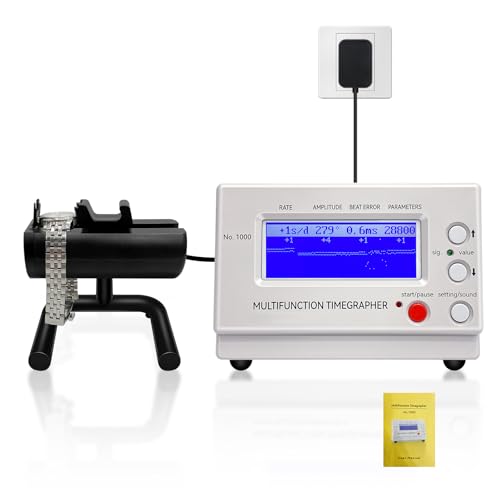
- Tests six core mechanical-watch parameters
- Offers 0.1 s/d resolution and dense sampling
- Compact with 100V-240V input support
Best For: Detailed movement diagnosis and calibration work
Precision Choice – SWANSOFT No.1000 Timegrapher
For watchmakers seeking watch timing machines for watchmakers with broad diagnostic coverage, the SWANSOFT No.1000 combines high-resolution readings with multi-position testing. It is designed for mechanical watches only, not quartz movements.
Best For: Professional watchmakers, technicians, and serious collectors servicing advanced, antique, or faulty mechanical movements.
Pros:
- Claims ±0.1 seconds/day accuracy using a 50-sample average, with a measurement range up to ±999 seconds/day.
- Displays rate, amplitude, beat error, lift angle, and timing curves on a color LCD.
- Supports six positions, 2–60-second sampling cycles, and adjustable 30°–70° lift angles.
- Includes 12-month support and a sensor or microphone-based escapement detection system.
Cons:
- Only suitable for mechanical movement watches.
- Its professional feature set may be more than casual users need.
This is the most feature-rich option in the group for detailed bench diagnostics. Its multi-position testing and wide measurement range make it particularly useful when calibrating varied mechanical movements.
Compact Diagnostic Pick – Pongnas Multifunction Timegrapher
The Pongnas Watch Tester is a practical entry in watch timing machines for watchmakers, providing real-time readings for core mechanical-watch timing measurements in a portable format.
Best For: Users who want a compact instrument for checking daily rate, amplitude, beat error, and frequency on mechanical watches.
Pros:
- Automatically calculates and displays rate, amplitude, and beat error in real time.
- LCD screen shows a frequency diagram and measurement readings.
- Offers 0.1-millisecond beat-error resolution and a 100°–360° swing measurement range.
- Portable design is described as easy to install and operate.
Cons:
- The supplied notes do not specify support for quartz watches or multiple testing positions.
- Some product dimensions appear unusually small in the listing details.
This model covers the fundamental measurements needed for routine mechanical-watch checks. It is best suited to buyers who prioritize straightforward operation and portability over advanced position-testing features.
USB-C Bench Option – Wristwatch USB-C Timegrapher
DBEIXIWEI Watch Timegrapher with USB Type-C Data Cable Wristwatch Timing Machine Calibration Tool
Check Price On AmazonThis USB-C timegrapher is a useful option among watch timing machines for watchmakers who want broad measurement capability and a modern cable connection. Its enclosed sensor design is intended to reduce outside noise during testing.
Best For: Amateur users and hobbyist watchmakers who need rate, amplitude, beat error, frequency, lift-angle, and waveform measurements.
Pros:
- Measures rate, amplitude, beat error, frequency, lift angle, and waveform.
- Includes a USB Type-C data cable.
- Uses a vibration sensor, power amplifier circuit, and enclosed noise-reduction cavity.
- The notes state that its microelectronic interior will not magnetize watches during tests.
Cons:
- It is described specifically as a high-precision instrument for amateur users rather than as a professional-grade system.
- The supplied notes do not list testing positions, accuracy figures, or supported movement types.
The broad parameter list makes this a flexible choice for home benches and learning environments. Buyers who need documented accuracy or multi-position testing should compare those specifications before choosing it.
Classic Workshop Pick – No.1000 Mechanical Timegrapher
The No.1000 Watch Tester is a straightforward choice among watch timing machines for watchmakers, offering coaxial testing for almost all mechanical watches in a compact, corded format.
Best For: Professional watchmakers and collectors wanting a dedicated mechanical-watch timing tool for workshop use.
Pros:
- Designed to test almost all mechanical watches using coaxial testing.
- Described as a multipurpose timegrapher used by professional watchmakers and collectors.
- Compact dimensions of approximately 6.77 × 1.57 × 4.49 inches.
- Uses corded electric power and carries CE specification compliance.
Cons:
- It is compatible with mechanical watches, with no quartz-watch support stated.
- The supplied notes do not provide accuracy, amplitude range, beat-error resolution, or position-testing details.
This model fits buyers who prefer a dedicated, compact No.1000 instrument without relying on a lengthy feature list. Its stated mechanical-watch compatibility makes it a focused workshop tool, but detailed specifications may require verification.
Best High-Visibility Pick – TICFROG No. 1900 Timegrapher
For watchmakers comparing watch timing machines for watchmakers, the TICFROG No. 1900 stands out with a larger, high-resolution color display. It measures rate deviation, amplitude, and beat error while showing beat number and lift angle in real time.
Best For: Watchmakers, collectors, and repairers who want clearer trace readings for calibration and troubleshooting.
Pros:
- Color screen displays separate entrance and exit traces.
- Measures rate deviation, amplitude, and beat error with stated precision.
- Supports one to six measuring positions and mechanical and coaxial watches.
- Includes a sensor, adapter, manual, and cleaning cloth.
Cons:
- The supplied notes do not specify a printer or computer data-transfer connection.
- Its broader display and functions may be more than casual users need.
The No. 1900 is a strong choice when visual trace separation matters during adjustment work. Its backlit interface and included accessories also make it practical for routine bench checks.
Best Established Value – WEISHI No. 1000 Timegrapher
The WEISHI No. 1000 is a practical option among watch timing machines for watchmakers, automatically calculating rate, amplitude, beat error, and beat number in real time. Its selectable sampling periods and six testing positions provide useful flexibility for bench testing.
Best For: Hobbyists and repair professionals seeking broad beat-rate support and straightforward timing measurements.
Pros:
- Automatically adjusts signal level during testing.
- Offers sampling periods from two to 60 seconds.
- Supports six testing positions and speaker or mute operation.
- Provides automatic and manual beat-rate selection across many values.
Cons:
- The blue LCD display is less visually detailed than a color trace display.
- No printer connection or time display is listed.
- The supplied power specification is 90–220 V, which buyers should verify for their setup.
Choose this model if measurement flexibility is more important than advanced display features. Its wide beat-rate selection and adjustable sampling make it suitable for varied mechanical watch testing.
Best for Connected Workflows – USB/RS232 Watch Timegrapher
For watchmakers who want computer-assisted analysis, this adjustable watch timing machine includes an acoustic pickup rail and PC data transfer through USB/RS232. It is designed to measure daily rate, amplitude, and beat error while also displaying broader signal and waveform information.
Best For: Users who want to transfer timing data to tablets, laptops, or desktop computers and accommodate different dial sizes.
Pros:
- Supports USB/RS232 data transfer to compatible computers and tablets.
- Includes adjustable sliding clips for different dial sizes.
- Displays signal value, daily rate, polarisation, oscillation frequency, and waveform information.
- Features an indicator light for quick power-status monitoring.
Cons:
- The supplied notes do not state measurement ranges or precision.
- Computer compatibility and connection setup may require checking before purchase.
- Its very compact listed dimensions may not suit users wanting a larger control surface.
This model is most compelling when recording or reviewing measurements on a computer is part of the workflow. Its adjustable clips add practical flexibility for securing watches of different dial sizes.
Best Large-Screen Upgrade – SWANSOFT No.1900 Timegrapher
For watchmakers comparing watch timing machines for watchmakers, the SWANSOFT No.1900 stands out for its larger, high-resolution color LCD screen and straightforward controls. It is designed for mechanical watches and displays rate, amplitude, beat error, beat, and lift angle during testing.
Best For: Watchmakers, technicians, collectors, and hobbyists who want an easy-to-read mechanical-watch tester with an upgraded display.
Pros:
- Larger, high-resolution color screen with a backlit display.
- Shows rate, amplitude, beat error, beat, and lift angle.
- Includes the timegrapher, sensor, US adapter, and professional manual.
- Backed by a stated one-year warranty and customer support.
Cons:
- Only supports mechanical movement watches, not quartz watches.
- Uses a corded power source and is not water resistant.
The No.1900 is a practical choice when screen readability matters at the workbench. Its feature set covers core timing checks, while the larger display may be especially useful for users who prefer clearly visible live readings.
Best Beginner-Friendly Option – TICFROG No.1000 Timegrapher
The TICFROG No.1000 is a sensible starting point for buyers exploring watch timing machines for watchmakers. It measures rate, beat rate, beat error, and amplitude, presenting results numerically and graphically to help users evaluate mechanical-watch accuracy.
Best For: Novice watchmakers and hobbyists learning to interpret mechanical-watch timing data.
Pros:
- Measures rate, beat rate, beat error, and amplitude.
- Displays readings both graphically and numerically.
- Features automatic signal-level adjustment.
- Includes a sensor, US adapter, user manual, and cleaning cloth.
Cons:
- Designed for mechanical watches rather than quartz movements.
- The supplied notes emphasize consulting the manual for proper use and advanced functions.
With the essential measurements needed for basic accuracy analysis, the No.1000 offers an accessible entry point into timegrapher use. It is a good fit for users who want core functionality without beginning with a more specialized feature set.
Best Measurement Range – Multifunctional No.1000 Watch Tester
For buyers needing broad measurement coverage, this No.1000 watch tester is one of the more specification-focused watch timing machines for watchmakers. It tests daily rate, beat amplitude, polarity, beat, lift angle, and period, with adjustable sampling and directional measurement options for mechanical-watch diagnosis.
Best For: Watchmakers, technicians, manufacturers, and enthusiasts who want detailed mechanical-movement testing in a compact unit.
Pros:
- Measures daily rate, amplitude, polarity, beat, lift angle, and period.
- Supports automatic standard-beat detection and manual special-beat selection.
- Offers 0.1 seconds-per-day resolution and 196 high-density sampling points.
- Compact design with 100V-240V ±10% wide-voltage input.
Cons:
- It is intended for mechanical watches, including manual-winding movements.
- The display resolution is listed as 192×64 pixels, smaller than a high-resolution color-screen model.
- Its broader settings may require more familiarity than a basic tester.
This model is most compelling when measurement flexibility and precision specifications matter more than a large display. Its sampling controls, polarity measurement, and wide input range make it a capable workbench tool for more involved mechanical-watch checks.
How We Picked the Best Watch Timing Machines for Watchmakers
We focused on the features that matter during real mechanical-watch testing: measurement of daily rate, amplitude, beat error, and beat rate; readable displays; microphone or acoustic pickup design; position testing; controls; and connection options. We also considered whether each machine appears suited to occasional hobby use, routine bench work, or more demanding repair environments.
Because specifications can vary by seller and production batch, verify the listing for included accessories, supported beat rates, power requirements, warranty coverage, and calibration information before ordering.
Quick Comparison
| What to compare | Why it matters |
|---|---|
| Core readings | Daily rate, amplitude, beat error, and beat frequency reveal different timing problems. |
| Display | A clear LCD or color screen makes readings easier to review while regulating. |
| Pickup and cable | A reliable microphone, rail, or USB-C connection helps capture a stable signal. |
| Position testing | Multiple positions show how consistently a movement performs on the wrist. |
| Build and controls | Stable placement and simple controls improve repeatability at the bench. |
Key Buying Factors for Watch Timing Machines
Measurement Range and Useful Readings
At minimum, choose a tester that reports daily rate, amplitude, beat error, and beat rate. These measurements help distinguish regulation issues from possible lubrication, magnetization, escapement, or mechanical problems. Automatic beat-rate detection is convenient, but manual selection can be useful when a signal is weak or unusual.
Signal Quality and Pickup Design
The acoustic pickup is central to reliable results. Look for a secure holder or pickup rail that keeps the case and microphone positioned consistently. A USB Type-C data cable may improve connectivity or power convenience, but confirm whether it transfers data, supplies power, or both.
Screen, Controls, and Workflow
A readable screen, straightforward menus, and quick access to position or beat settings reduce interruptions during regulation. If you test several watches in sequence, stable readings and easy resets may matter more than extra modes.
Calibration and Repeatability
A timegrapher is a diagnostic aid, not a substitute for sound service technique. Use a fully wound movement, allow readings to settle, and test several positions. Select a model with documented calibration guidance when measurement consistency is especially important.
Who Should Buy Which Watch Timing Machines for Watchmakers?
For beginners and occasional hobbyists: A straightforward No.1000-style tester is usually the sensible starting point. Prioritize clear readings, simple controls, and a dependable pickup over advanced display features.
For home watchmakers: Choose a multifunction model with several position settings and stable acoustic pickup. USB-C connectivity can be useful if it simplifies setup, but it should not outweigh measurement reliability.
For professional repair benches: Consider a clearer No.1900-style display or a well-equipped tester that supports repeatable measurements across positions. Confirm beat-rate compatibility, accessory availability, and after-sales support before buying multiple units.
For diagnosing inconsistent movements: Select the model that makes rate, amplitude, and beat-error trends easiest to monitor. The most useful machine is the one that produces repeatable data you can compare before and after adjustment.